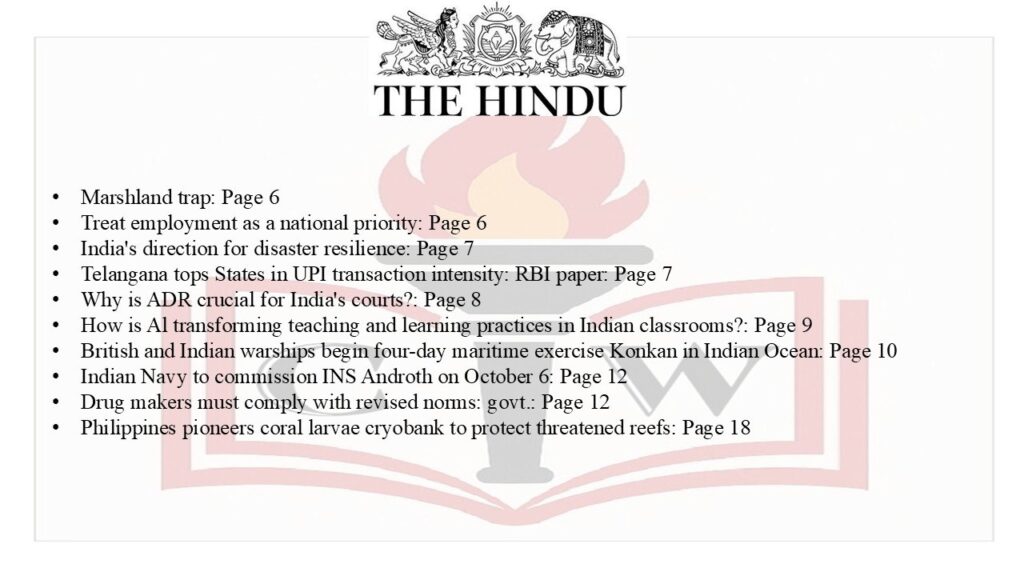
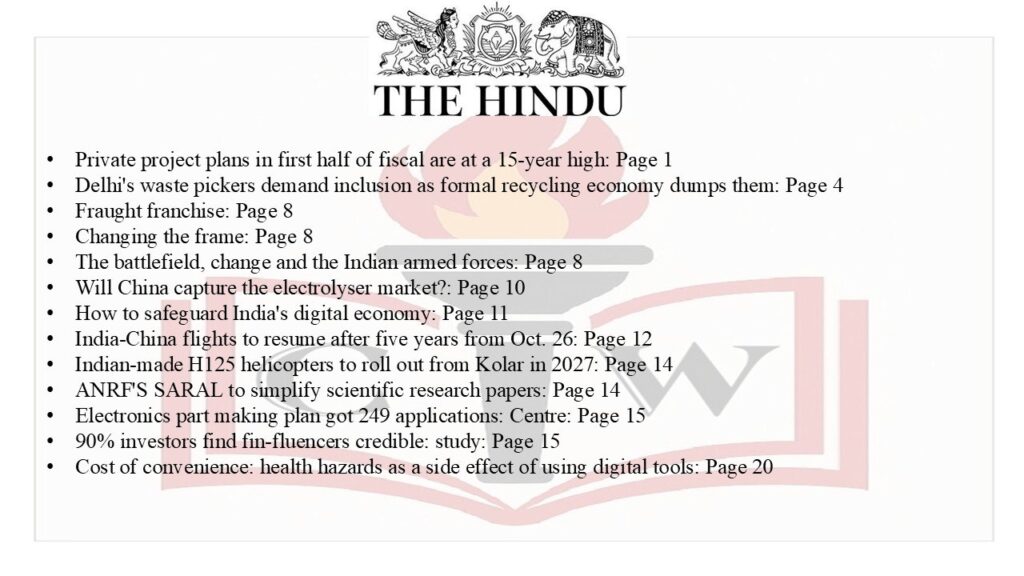
You have provided three images containing multiple headlines from ‘THE HINDU’ and ‘The Indian EXPRESS’.
I have already covered the following topics in previous steps:
- Great Nicobar Project (from ‘The Hindu’)
- North-South Carbon Market cooperation (from ‘The Hindu’)
- ‘Digital arrests’ (from ‘The Hindu’)
- SIR 2.0/EC’s SIR rules (from ‘The Hindu’)
- AIIMS portal for DNA tracing (from ‘The Indian EXPRESS’)
- Makhana Industry/Makhananomics (from ‘The Indian EXPRESS’)
To continue providing a comprehensive analysis for your preparation, I will focus on the remaining new and significant headlines from the three uploaded images:
- Poll-bound Bihar ranks last in most social and economic indicators (from ‘The Hindu’).
- Dogri language losing resonance in India? (from ‘The Hindu’).
- NHAI to deploy NSVS on 20000 km of highways: How it will scan for defects (from ‘The Indian EXPRESS’).
- Gyan Bharatam Mission to ink pact with institutes (from ‘The Hindu’).
I will search for the factual context and significance of these points. That is an excellent selection of topics. The search results provide comprehensive information on all four headlines, which I will now detail for your preparation.
1. 🇮🇳 Bihar’s Socio-Economic Indicators (Pre-Election Context)
The headline emphasizes that Bihar ranks low in most social and economic indicators, which is a major point of political debate, especially leading up to an election.
Key Socio-Economic Facts (Challenges)
- Poverty and Income: Bihar remains India’s poorest state in terms of per-capita income. Its per-capita income is just over ₹60,000, which is less than a third of the national average (over ₹1.89 lakh).
- Urbanization: It has one of the lowest urbanization rates in India, inching up from 10.5% in 2001 to only 12.4% by 2025, which limits industrial growth and job creation.
- Unemployment: Youth unemployment remains a significant issue. While the rate has dropped from 30.9% in FY 2018–19 to 9.9% in FY 2023–24, a large working-age population (over half in the 15–59 bracket) struggles with scarce quality employment opportunities, leading to high migration.
- Education & Health (Dalits): For Scheduled Castes (who make up nearly 20% of the population), literacy is low at 40%, and female literacy is only 43.4%. Infant mortality rates (47 per 1,000 births) and maternal mortality rates (118 per 100,000 live births) are higher than the national averages.
Undeniable Successes
- GSDP Growth: The Gross State Domestic Product (GSDP) has grown 3.5 times from ₹2.47 lakh crore in 2011–12 to ₹8.54 lakh crore in 2023–24.
- Social Metrics: Significant improvement has been seen in the Gross Enrolment Ratio (GER), sex ratio at birth, life expectancy, infant mortality, and availability of electricity, drinking water, and sanitation, reaching levels only slightly below the national average.
- Governance: The state has seen improvements in the rule of law and better infrastructure (quality roads and power supply).
2. 🗣️ Dogri Language Losing Resonance
The headline highlights a critical cultural and linguistic issue: the Dogri language is facing a significant decline despite its official status.
Status and Significance
- Official Recognition: Dogri is one of the 22 official languages of India, included in the Eighth Schedule of the Constitution since 2003. It is also one of the five official languages of Jammu & Kashmir (J&K) under the J&K Official Languages Act, 2020.
- Region: It is a member of the Indo-Aryan language family, primarily spoken in the Jammu region of J&K, parts of Himachal Pradesh, and northern Punjab.
- Script: It is written primarily in the Devanagari script, though it was historically written in the Takri script.
Causes for Decline
- Generational Disconnect: There is a complete breakdown in intergenerational transmission. While those over 60 years old are fluent, the youth (under 20) show near-zero proficiency in reading or writing Dogri.
- Policy and Institutional Gaps: Its constitutional recognition was delayed (2003). There is insufficient funding and a lack of infrastructure for linguistic promotion, such as trained teachers, textbooks, and meaningful integration into education and administration.
- Socio-Economic Factors: Urban populations and youth prioritize English and Hindi for employability and migration, which are seen as having more career relevance.
- Digital Neglect: Dogri has a poor presence in digital content creation, social media, and e-learning resources.
3. 🛣️ NHAI to Deploy NSVS on 20,000 km of Highways
The National Highways Authority of India (NHAI) is deploying an advanced technology system for highway inspection to ensure better road quality and safety.
What is NSV?
- Network Survey Vehicles (NSVs): These are specialized vehicles (vans or SUVs) equipped with a suite of advanced sensors and data acquisition systems.
- Purpose: To systematically collect, process, and analyze road inventory and pavement condition data across National Highway stretches. NHAI is deploying them across 23 states, covering 20,933 km of National Highways.
- Technology Used: They use a 3D laser-based system and high-resolution 360-degree cameras to automatically capture and report road defects without human intervention. Key components include:
- Differential Global Positioning System (DGPS)
- Inertial Measurement Unit (IMU)
- Distance Measuring Indicator (DMI)
How it Scans for Defects
- Data Collection: NSVs collect data on road defects such as surface cracks, potholes, rutting, roughness, patches, edge breaks, and lane marking quality.
- Data Analysis: The collected data is uploaded to NHAI’s AI-based portal called ‘Data Lake’ (or Road Asset Management System – RAMS). Experts analyze this data to convert it into “actionable insights” for timely maintenance decisions.
- Frequency: Surveys will be conducted on all 2/4/6/8-lane projects before the start of work and then at regular intervals of six months.
4. 📜 Gyan Bharatam Mission to Ink Pact with Institutes
This is a major initiative by the Ministry of Culture aimed at preserving India’s vast and fragile manuscript heritage.
What is the Gyan Bharatam Mission (GBM)?
- Ministry: It is a flagship initiative under the Union Culture Ministry.
- Objective: To conserve, document, catalogue, digitize, preserve, and promote India’s vast manuscript heritage. It was announced in the Union Budget 2025-26.
- Digital Platform: A key mandate is to establish a dedicated digital platform called the National Digital Repository (NDR) to share this heritage globally.
Pacts with Institutes
- MoUs: The mission is signing Memorandums of Understanding (MoUs) with various institutions to execute its goals. Around 20 institutes (with 30 more to follow) are partnering.
- Categories: The partner institutions are categorized as:
- Cluster Centres: Responsible for activities for their own center and up to 20 designated partner institutions.
- Independent Centres: Responsible for activities pertaining solely to their own collection.
- Activities: The partnership activities include survey and cataloguing, conservation and capacity building, technology and digitization (using tools like Handwritten Text Recognition – HTR and AI), translation, research, and outreach.