Newspaper

To be read in The Indian Express & The Hindu : 09/10/2025

Here is a focused analysis of the impact of the CBAM levy on Indian exporters, and how it connects with other policy issues we’ve covered: 🇪🇺 Analysis: The CBAM Challenge and India’s Steel Industry The headline “Indian iron and steel exporters face the highest CBAM levy” signals a major shift in international trade policy where carbon emissions are directly translated into a tariff burden for exporters to the European Union (EU). 1. The Mechanics and Financial Impact 2. Connection to India’s Climate and Clean Energy Goals The CBAM directly links India’s trade policy to its domestic climate action, aligning with other headlines in the report: 3. Strategic Challenge The CBAM is a major challenge for India’s manufacturing-led growth strategy, as it penalises the carbon-intensive manufacturing processes currently dominant in the steel sector. The CBAM is a real-world example of how environmental policy is becoming the next frontier in global trade wars, requiring India to pivot its industrial and climate strategies simultaneously.

To be read in The Indian Express & The Hindu : 09/10/2025 Read More »

To be read in The Indian Express & The Hindu : 08/10/2025

Based on all the headlines across Economic, Security, Environmental, and Governance domains, here are the three most significant, interconnected policy priorities facing the Indian government: 🎯 Top 3 Policy Priorities for the Indian Government The recent national headlines highlight that India’s policy focus is divided between (1) navigating complex global economic headwinds, (2) addressing severe domestic social and environmental deficits, and (3) strategically modernizing its digital and defence infrastructure. Priority 1: Securing Growth and Strategic Autonomy amid Global Fragmentation The primary economic challenge is maintaining a high growth trajectory (IMF forecasts India’s growth at 6.6% in 2025) while managing significant international pressures that threaten its trade and energy security. Priority 2: Closing the Social & Environmental Implementation Gap There is a clear divide between announced policies and their effective implementation, particularly in environmental protection, social welfare, and judicial efficiency. Priority 3: Battling Modern Digital & Cyber Threats Rapid digitization has introduced new, large-scale threats to both national security and individual citizens that require immediate policy intervention.

To be read in The Indian Express & The Hindu : 08/10/2025 Read More »

To be read in The Indian Express & The Hindu : 07/10/2025

now synthesize the new information and present the final three strategic priorities, enhanced by the latest headlines. 🎯 Top 3 Policy Priorities for the Indian Government (Enhanced Synthesis) The comprehensive analysis across all headlines reveals that the government’s strategic focus is heavily concentrated on three interconnected areas: (1) Economic Resilience against Global Headwinds, (2) Strategic Security & Technology Upgradation, and (3) Bridging the Implementation Gap in Governance and Social Policy. Priority 1: Securing Economic Resilience and Growth The challenge is to maintain a high-growth economy (IMF forecasts India’s growth at 6.6% in 2025) while dealing with external trade barriers and internal financial stability issues. Challenge Area Key Development Strategic Implication Global Trade Barriers India’s iron and steel exporters face the highest CBAM levy from the EU; China files WTO complaint against India’s EV subsidies. Requires rapid industrial decarbonization (“The ‘critical factor’ in India’s clean energy ambitions”) and aggressive defence of domestic industrial policy at international forums. Financial Stability RBI may limit banks’ market exposure; RBI waits & watch amid uncertainty. Signals caution on financial risks and a focus on maintaining stability to support policy transmission (“RBI changes loan rules: New norms likely to boost policy transmission”). Digital Economy UPI leads in payment volume; Telangana tops States in UPI transaction intensity. Must sustain momentum in digital finance while the RBI urges central banks to promote CBDCs over stablecoins to secure the digital currency ecosystem. Domestic Growth “India needs 12%+ GDP growth to solve jobs problem, address unemployment”. Employment must be treated as a national priority and industrial planning must be robust (Private project plans in first half of fiscal are at a 15-year high). Priority 2: Strategic Security and Technology Upgradation This involves a rapid, indigenous overhaul of India’s military, space, and digital defence capabilities to meet both traditional and new-age security threats. Security Domain Key Development Strategic Implication Defence Modernization DAC grants AoN for capital acquisition proposals worth ₹79,000 crore for the Tri-services. Commitment to indigenous production (e.g., Indian-made H125 helicopters to roll out from Kolar in 2027) and modernizing warfare (“Energy weapons, satellites, radar network key to Sudarshan Chakra”). Space & Science ‘90% of Gaganyaan development work done’. Focus on high-stakes technology and ensuring safety (How does Gaganyaan’s vital crew escape system work?). This is part of a larger push for global leadership in science. Cyber & AI Threats EC warns parties against misuse of AI-generated content; “The growing menace of deepfakes”. Requires proactive regulatory action to safeguard democracy, alongside boosting domestic capability (“Quantum leap by Indian researchers in boosting digital security”). Priority 3: Bridging the Governance and Social Implementation Gap The judiciary is actively pushing the executive to fulfill its basic duties, highlighting systemic failures in enforcement, particularly at the state level. Governance Issue Key Development Strategic Implication Judicial Enforcement Failure SC raps States for no action on its order on stray dogs and for laxity in framing hospital norms. The implementation gap remains a massive hurdle; the government must also clear the Forest Rights Act backlog (“Centre urges states to clear Forest Rights Act backlog; 15% claims pending”). Cybercrime & Public Safety SC takes action on people running from pillar to post over ‘digital arrests’. Requires urgent, coordinated, pan-India police action to combat high-tech fraud and restore public trust. Key Appointments & Oversight Centre tells top court it will make CIC appointments in ‘two or three’ weeks. Signals executive delay in filling crucial oversight positions, which is necessary for democratic accountability. This final summary provides a holistic view of India’s current policy landscape.

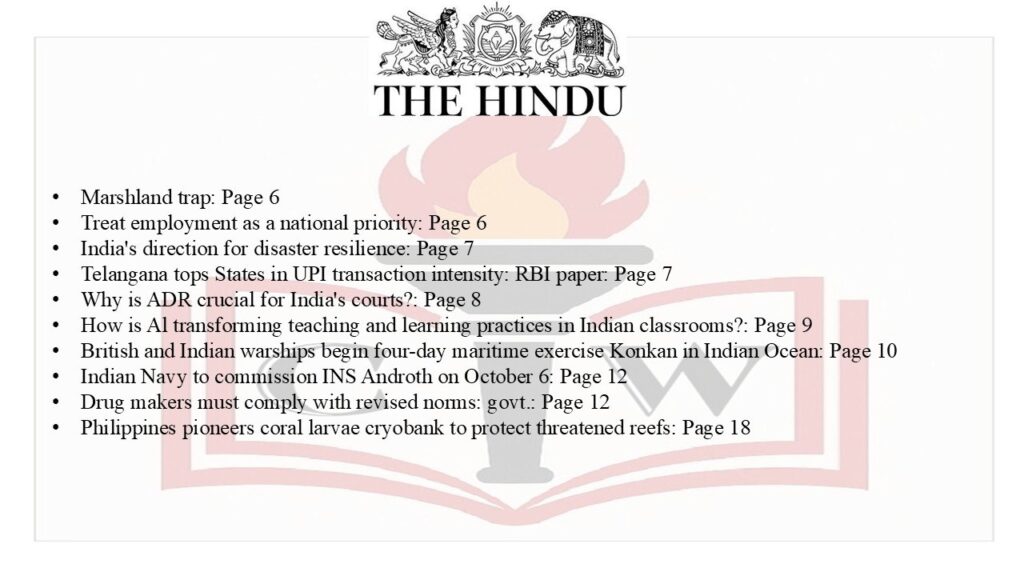
To be read in The Indian Express & The Hindu : 07/10/2025 Read More »

To be read in The Indian Express & The Hindu : 06/10/2025

Here is an analysis of the key developments and challenges in this domain, based on the headlines: 🚀 Deep Dive: Strategic Security and Technology Upgradation This policy priority is characterized by major investments in defense self-reliance, ambitious space missions, and the proactive governance of emerging technologies like AI and quantum computing. 1. Defence Modernization and Strategic Alliances India is focusing heavily on indigenous defense capability and building strong maritime and strategic partnerships. 2. Space and Science Ambitions India’s space program, driven by ISRO, is on the cusp of a major human spaceflight milestone, while R&D is pushing digital frontiers. 3. Governing AI and Digital Security The rapid adoption of digital technology presents governance and security risks, particularly with the rise of AI-driven media. In summary, the policy priority is a balanced three-pronged approach: funding traditional military assets, rapidly developing high-tech space capabilities, and proactively legislating against the new cyber threats inherent in the digital age.

To be read in The Indian Express & The Hindu : 06/10/2025 Read More »

To be read in The Indian Express & The Hindu : 03/10/2025

Here is a focused analysis on India’s geopolitical tightrope walk, covering the energy dispute and the strategic importance of the Great Nicobar project: 🌍 Geopolitical Tightrope: Energy, Sanctions, and Strategic Territory India’s recent headlines demonstrate a policy of strategic autonomy, balancing discounted energy needs with Western sanctions, while simultaneously pursuing major infrastructure projects to secure its regional maritime position. 1. The Russian Oil Dilemma: Balancing East and West India’s energy policy is dictated by the need for stable prices and secure supplies. This has led to a direct geopolitical conflict regarding discounted Russian crude oil: 2. The Strategic Importance of Great Nicobar The proposed Great Nicobar project is positioned as a key move to bolster India’s maritime trade and strategic presence in the Indian Ocean Region (IOR). 3. Managing Regional and Global Geopolitics India is simultaneously engaging in diplomacy to secure its short-term interests and its long-term vision for a reformed global order. In summary, India is operating under the principle of strategic autonomy. It will procure essential resources from wherever they are available (Russian oil) until forced by sanctions to comply, while simultaneously pushing forward major projects (Great Nicobar) that enhance its long-term strategic and economic power, regardless of immediate domestic or international headwinds.

To be read in The Indian Express & The Hindu : 03/10/2025 Read More »

    Book Your Free Demo Classes

    Powered by