October 2025

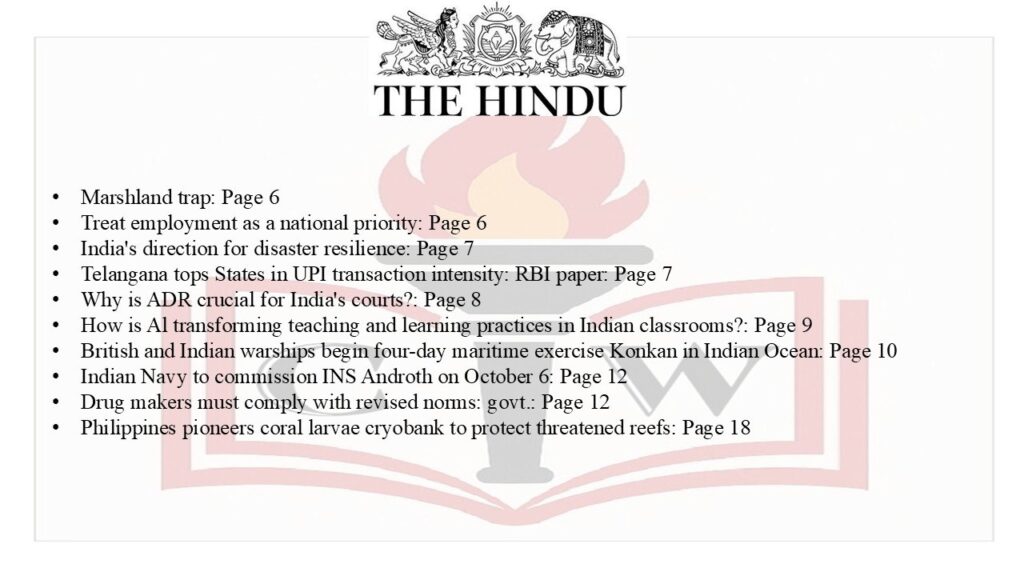
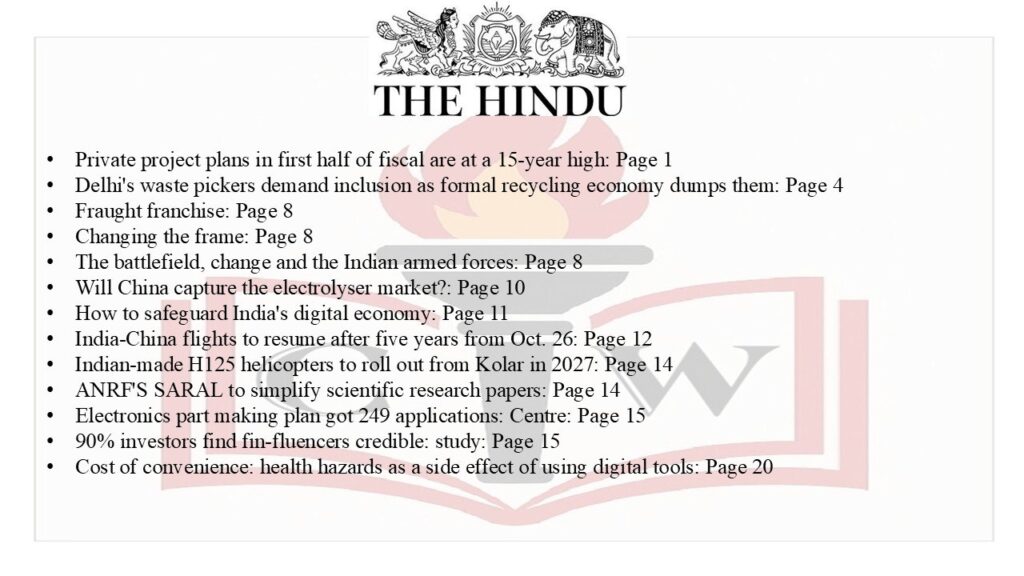
To be read in The Indian Express & The Hindu : 06/10/2025

Here is an analysis of the key developments and challenges in this domain, based on the headlines: 🚀 Deep Dive: Strategic Security and Technology Upgradation This policy priority is characterized by major investments in defense self-reliance, ambitious space missions, and the proactive governance of emerging technologies like AI and quantum computing. 1. Defence Modernization and Strategic Alliances India is focusing heavily on indigenous defense capability and building strong maritime and strategic partnerships. 2. Space and Science Ambitions India’s space program, driven by ISRO, is on the cusp of a major human spaceflight milestone, while R&D is pushing digital frontiers. 3. Governing AI and Digital Security The rapid adoption of digital technology presents governance and security risks, particularly with the rise of AI-driven media. In summary, the policy priority is a balanced three-pronged approach: funding traditional military assets, rapidly developing high-tech space capabilities, and proactively legislating against the new cyber threats inherent in the digital age.

To be read in The Indian Express & The Hindu : 06/10/2025 Read More »

DAILY CURRENT AFFAIRS IAS | UPSC Prelims and Mains Exam – 4th October – 2025

Archives (PRELIMS  Focus) Stablecoins Category: Economy Context: Hinting at a possible shift in India’s cryptocurrency policy, Union Finance Minister said countries would have to “prepare to engage” with stablecoins whether they welcome the change or not. About Stablecoins: Nature: Stablecoins are a type of cryptocurrency that attempt to maintain stable prices as they are pegged to an underlying asset, such as a basket of currencies or precious metals like gold. Terminology: Although the term “stablecoin” is commonly used, there is no guarantee that the asset will maintain a stable value in relation to the value of the reference asset when traded on secondary markets or that the reserve of assets, if there is one, will be adequate to satisfy all redemptions. Difference with cryptocurrencies: Stablecoins are designed for everyday use, offering price stability unlike volatile cryptocurrencies like Bitcoin. They enable easy value transfer, support financial services, and maintain stability through collateral reserves or algorithmic supply control.  Popular stablecoins like Tether and USD Coin are backed by the US dollar. Types of Stablecoins: There are primarily three types of stablecoins: fiat-collateralized, crypto-collateralized, and non-collateralized (algorithmic). Fiat-collateralized stablecoins are pegged to a specific asset, such as a fiat currency.  The entity behind the stablecoin maintains a reserve of the asset or assets backing the stablecoin, supporting the value of the digital currency.  On the other hand, non-collateralized (algorithmic) stablecoins use software algorithms to automatically adjust the supply of the stablecoin based on demand, aiming to maintain a stable price. Status of stablecoins in India: India does not currently recognise stablecoins, treating all cryptocurrencies as Virtual Digital Assets (VDAs) under Section 2(47A) of the Income Tax Act, 1961. In 2023, VDAs were brought under the Prevention of Money Laundering Act, 2002, to curb misuse and enhance oversight. Central Bank Digital Currency (CBDC) or ‘Digital Rupee’ is India’s official alternative to stablecoins, which allows programmable payments (e.g., Direct Benefit Transfer (DBT) schemes), tracking usage by expiry, location, or purpose. Source: The Hindu Banni Festival Category: History & Culture Context: Two people were killed and more than a hundred were injured at the annual Banni festival at Devaragattu in Kurnool district of Andhra Pradesh. About Banni Festival: Nature: It is a tradition in Andhra Pradesh where villagers fight with sticks to claim a deity’s idol on Vijayadashami. The objective of this event is to snatch the idols from the God’s team, leading to a fierce battle known as the Banni Fight. Occasion: It is celebrated on the night of Dussehra celebration (Vijaya Dasami) every year. Location: It is held on the premises of Mala Malleswara Swamy Temple (situated at the border of Andhra Pradesh and Karnataka). Linkage with Vijayanagara Empire: This festival was celebrated by people under the Vijayanagara Empire. Significance: It is celebrated on the account of the victory of Lord Mala Malleswara Swamy and Goddess Parvati over demonish Mani and Mallasura, who troubled the people at Devaragattu region. Rituals: The ritual takes place at midnight when the procession of idols of the ruling deities Malamma (Parvati) and Malleshwara Swamy (Shiva) are brought down the hill temple at Neraneki. Devotees carry long sticks or lathis with them for hitting each other with these sticks on the head. The basic idea of this fight is to capture the procession idol. Source: The Hindu Presumptive Taxation Category: Economy Context: The government think tank Niti Aayog suggested the introduction of a presumptive taxation scheme for foreign companies to provide certainty and simplicity. About Presumptive Taxation: Nature: It is a simplified tax scheme where income is calculated based on a presumed rate of profit rather than actual income. Need: Despite India’s inherent appeal and remarkable FDI growth, structural impediments such as ambiguous PE (permanent establishment), regulations introduce tax uncertainty and dampen investments. Objectives: To provide relief to taxpayers from the tedious work of maintaining regular books of account under certain circumstances. To provide tax certainty and reduce compliance burdens. To align with India’s goal of becoming a global manufacturing hub under initiatives like Make in India. Importance: The optional presumptive taxation scheme would help resolve disputes concerning PE (permanent establishment), simplifying compliance and protecting revenue. By adopting a presumptive taxation scheme, India can transform its tax regime from a ‘minefield’ into a ‘well-lit path.’ Impact on businesses: A company opting for this scheme can declare income at a prescribed rate; in lieu of that, it is relieved from maintaining books of accounts for audit by tax authorities. Source: The Hindu NATO Category: International Relations Context: A quarter of a century after it joined NATO, Poland will finally join the alliance‘s fuel pipeline network, amid rising tension on its eastern frontier. About NATO: Nature: The North Atlantic Treaty Organization (NATO) is an intergovernmental military alliance. Formation: It was established on April 4, 1949, with the signing of the North Atlantic Treaty in Washington, D.C. by 12 founding member countries from Europe and North America. Objective: It was established with the primary goal of providing collective defence against potential aggression, particularly from the Soviet Union during the Cold War era. Over the years, NATO has evolved to address a range of security challenges beyond its original mandate. Uniqueness: NATO’s primary mission is collective defence, as outlined in Article 5 of the North Atlantic Treaty. This article stipulates that an attack on one member country will be considered an attack on all, and the members will respond collectively. Founding members: The original 12 founding members of NATO were Belgium, Canada, Denmark, France, Iceland, Italy, Luxembourg, the Netherlands, Norway, Portugal, the United Kingdom, and the United States. Expansion: NATO has expanded since its founding, with new member countries joining in multiple rounds. The alliance currently consists of 32 member countries. Political Leadership: The North Atlantic Council (NAC) serves as NATO’s principal political decision-making body, composed of ambassadors from all member countries. Funding: In 2006, NATO Defense Ministers agreed to a commitment that 2% of their countries’ GDP would be allocated towards defence spending. However, the majority of NATO members do not meet this

DAILY CURRENT AFFAIRS IAS | UPSC Prelims and Mains Exam – 4th October – 2025 Read More »

DAILY CURRENT AFFAIRS IAS | UPSC Prelims and Mains Exam – 3rd October – 2025

Archives (PRELIMS  Focus) Sir Creek Category: International Relations Context: Defence Minister Rajnath Singh warned Pakistan that “any aggression by Pakistan in the Sir Creek area will be met with a resounding response that will change both history and geography.” About Sir Creek: Disputed area: Sir Creek is a 96-km strip of water disputed between India and Pakistan in the Rann of Kutch marshlands. Nomenclature: Originally named Ban Ganga, Sir Creek is named after a British representative. Acts as a boundary: The Creek opens up in the Arabian Sea and roughly divides the Kutch region of Gujarat from the Sindh Province of Pakistan. Importance: Apart from strategic location, Sir Creek’s core importance is fishing resources. Sir Creek is considered to be among the largest fishing grounds in Asia. Possibility of oil and gas: The area has possible presence of great oil and gas concentration under the sea, which are currently unexploited thanks to the impending deadlock on the issue. Background of dispute: The dispute lies in the interpretation of the maritime boundary line between Kutch and Sindh. Pakistan claims the entire creek as per paragraphs 9 and 10 of the Bombay Government Resolution of 1914 signed between then the Government of Sindh and Rao Maharaj of Kutch, which set the boundary as the eastern flank of the creek popularly known as Green Line. But India claims that the boundary lies mid-channel as depicted in another map drawn in 1925, and implemented by the installation of mid-channel pillars back in 1924. In its support, it cites the Thalweg Doctrine in International Maritime Law, which states that river boundaries between two states may be divided by the mid-channel if the water-body is navigable. UNCLOS favours India’s stand: Acceding to India’s stance would mean shifting of the land/sea terminus point several kilometres to the detriment of Pakistan, leading in turn to a loss of several thousand square kilometres of its Exclusive Economic Zone under the United Nations Convention on Law of the Sea (UNCLOS). Sources: The Hindu Kathakali Category: History & Culture Context: Kerala Kalamandalam, Cheruthuruthy, witnessed history when 16-year-old Sabri, became the first Muslim girl to perform Kathakali at the prestigious institution since its founding in 1930. About Kathakali: Origin: Kathakali emerged in the 17th century in the kingdom of Travancore (present-day Kerala). The art form was initially performed in temple precincts and later gained popularity in the royal courts. Based on ancient texts: Kathakali is based on Natya Shastra, the ancient treatise on dance, written by Sage Bharata. However, It relies on Hasthalakshana Deepika, another classical text for its hand gestures. Precursors: Dance-drama art form called ‘Krishnanattam’ and Ramanattam based on Mahabharata and Ramayana are precursor of ‘Kathakali’. Composition: Kathakali combines elements of dance, music, mime, and drama. Features of dance: The four aspects of abhinaya – Angika, Aharya, Vachika, Satvikaand the Nritta, Nritya and Natya are combined perfectly in this dance form. Features of music: Kathakali music follows the traditional sopana sangeet of Kerala. It is said to be the ritual singing of the Ashtapadis on the flight of steps leading to the sanctum sanctorum. Use of Mudras: The movements are highly stylized and include intricate footwork, rhythmic swaying, and various hand gestures called mudras. Emphasis on facial expressions: The dancers use their facial expressions, known as rasas, to convey emotions and tell stories. Downfall in 20th century: Kathakali was in peril and on the verge of extinction in the beginning of 20th century. Revival: Renowned Poet Vallaththol Narayana Menon and Manakkulam Mukunda Raja took the initiative to set up Kerala Kalamandalam, a centre of excellence for classical art forms for the revival of kathakali. Major exponents: Kavungal Chathunni Panicker and Kalamandalam Gopi are its most eminent representatives. Source: The Hindu Thumri Category: History & Culture Context: Thumri (one of the ten main styles of singing in Hindustani music) lost its voice as Pandit Chhannulal Mishra passed away leaving a musical legacy. About Hindustani Music: Origin: While the historical roots of both the music types belong to the Bharata’s Natyasastra, they diverged in the 14th century. Focus: The Hindustani branch of music focuses more on the musical structure and the possibilities of improvisation in it. The Hindustani branch adopted a scale of Shudha Swara Saptaka or the ‘Octave of Natural notes’. Composition: The Hindustani music has elements of ancient Hindu tradition, Vedic philosophy and Persian tradition as well. Based on teacher-disciple tradition: Since ancient times, it has been passed from one to another through the Guru-Shishya Parampara. Musical instruments: The musical instruments used in Hindustani are Tabla, Sarangi, Sitar, Santoor, Flute and violin. Raga system: It is based on the Raga system. The Raga is a melodic scale comprising of basic seven notes. Major styles: There are ten main styles of singing in Hindustani music like the Dhrupad, Khayal, Tappa, Chaturanga, Tarana, Sargam, Thumri and Ragasagar, Hori and Dhamar. About Thumri: Origin: Originated in Eastern Uttar Pradesh, mainly in Lucknow & Benares, around 18th century. A romantic & erotic style of singing; also called “the lyric of Indian classical music.” Themes: Compositions are mostly on love, separation and devotion. Distinct feature: Erotic subject matter portrayed picturesquely from the various episodes of the lives of Lord Krishna & Radha. Language: Lyrics are typically in Brij Bhasha and are usually romantic & religious. Linkage with Khayal: A Thumri is usually performed as the last item of a Khayal concert. Gharanas: Three main gharanas of thumri are Benaras, Lucknow and Patiala. Exponent: Begum Akhtar is one of the most popular singers of thumri style. Source: The Hindu ICDS Scheme Category: Government Schemes Context: Recently, Integrated Child Development Services (ICDS) scheme completed 50 years of its launch. About ICDS:   Launch: Launched in 1975, it is one of the world’s largest programmes providing for an integrated package of services for the holistic development of the child.  Ministry: The Umbrella ICDS is a centrally sponsored scheme implemented by the Ministry of Women and Child Development. Flagship programme: The ICDS Scheme providing for supplementary nutrition, immunization and

DAILY CURRENT AFFAIRS IAS | UPSC Prelims and Mains Exam – 3rd October – 2025 Read More »

To be read in The Indian Express & The Hindu : 03/10/2025

Here is a focused analysis on India’s geopolitical tightrope walk, covering the energy dispute and the strategic importance of the Great Nicobar project: 🌍 Geopolitical Tightrope: Energy, Sanctions, and Strategic Territory India’s recent headlines demonstrate a policy of strategic autonomy, balancing discounted energy needs with Western sanctions, while simultaneously pursuing major infrastructure projects to secure its regional maritime position. 1. The Russian Oil Dilemma: Balancing East and West India’s energy policy is dictated by the need for stable prices and secure supplies. This has led to a direct geopolitical conflict regarding discounted Russian crude oil: 2. The Strategic Importance of Great Nicobar The proposed Great Nicobar project is positioned as a key move to bolster India’s maritime trade and strategic presence in the Indian Ocean Region (IOR). 3. Managing Regional and Global Geopolitics India is simultaneously engaging in diplomacy to secure its short-term interests and its long-term vision for a reformed global order. In summary, India is operating under the principle of strategic autonomy. It will procure essential resources from wherever they are available (Russian oil) until forced by sanctions to comply, while simultaneously pushing forward major projects (Great Nicobar) that enhance its long-term strategic and economic power, regardless of immediate domestic or international headwinds.

To be read in The Indian Express & The Hindu : 03/10/2025 Read More »

DAILY CURRENT AFFAIRS IAS | UPSC Prelims and Mains Exam – 1st October – 2025

Archives (PRELIMS  Focus) Foreign Contribution Regulation Act (FCRA) Category: Polity & Governance Context: The Union Ministry of Home Affairs directed NGOs to submit applications for renewal of their Foreign Contribution (Regulation) Act (FCRA) registration at least four months before expiry. About Foreign Contribution (Regulation) Act (FCRA), 2010: Nature: The Foreign Contribution (Regulation) Act (FCRA), 2010, regulates foreign contributions to protect national sovereignty and security. It governs the receipt and use of foreign contributions by individuals, associations, and companies operating in India. Objective: The FCRA 2010 aims to ensure that foreign donations do not compromise the nation’s sovereignty or internal security. Amendments: Amendments were made in 2020 which brought certain changes. About Foreign Contribution (Regulation) Amendment Act, 2020: Validity & Renewal: FCRA registration is valid for five years, and NGOs are required to apply for renewal within six months of the registration’s expiry. Mandates Aadhaar: Office bearers must provide an Aadhaar or passport/OCI card for registration. Need for SBI account: Contributions must be received in a designated SBI branch in New Delhi. Puts a cap on administrative Use: Administrative expense limits were reduced from 50% to 20%. Suspension Extension: Initially, registration suspension can be enforced for a period of 180 days. This suspension can be further extended by an additional 180 days. Prohibits certain activities The applicant must not represent fictitious entities. The applicant should not have been involved in religious conversion activities, either directly or indirectly. The applicant must not be engaged in activities related to sedition. The FCRA prohibits candidates, journalists, media companies, judges, government servants, politicians, and political organizations from receiving foreign funds. FCRA Rules 2022 In July 2022, the MHA introduced changes to FCRA rules. These changes included increasing the number of compoundable offences from 7 to 12. The rules also raised the limit for contributions from relatives abroad that do not require government intimation from Rs 1 lakh to Rs 10 lakh and extended the time limit for intimation of the opening of bank accounts. Source: The Hindu Interstellar Mapping and Acceleration Probe (IMAP) Category: Science & Technology Context: Recently, NASA launched the Interstellar Mapping and Acceleration Probe (IMAP) to map the heliosphere’s boundary, trace energetic particles, and improve space weather forecasting. About IMAP: Nature: The Interstellar Mapping and Acceleration Probe, or IMAP, will explore and map the very boundaries of our heliosphere, a huge bubble created by the Sun’s wind that encapsulates our entire solar system. Functioning: The IMAP mission will use 10 scientific instruments to chart a comprehensive picture of what’s roiling in space, from high-energy particles originating at the Sun, to magnetic fields in interplanetary space, to remnants of exploded stars in interstellar space. Mass of the spacecraft: It weighs around 900 kilograms (1,984 pounds). Launch vehicle: It is launched using Falcon 9, which is a partially reusable, two-stage-to-orbit, medium-lift launch vehicle designed and manufactured by SpaceX. Location: The IMAP spacecraft is situated at the first Earth-Sun Lagrange point (L1), at around one million miles from Earth toward the Sun. There, it can provide about a half hour’s warning to voyaging astronauts and spacecraft near Earth of harmful radiation coming their way. Investigating heliophysics: The mission will primarily investigate two of the most important overarching issues in heliophysics, viz. how charged particles from the Sun are energized to form what’s known as the solar wind and how that wind interacts with interstellar space at the heliosphere’s boundary. Help astronauts: The IMAP mission will additionally support real-time observations of the solar wind, which can flood the near-Earth space environment with dangerous particles and radiation that could harm technology and astronauts in space and disrupt global communications and electrical grids on Earth. Expected outcomes of the mission: Uncover fundamental physics at scales both tiny and immense.  Improve forecasting of solar wind disturbances and particle radiation hazards from space. Draw a picture of our nearby galactic neighborhood. Help determine some of the basic cosmic building materials of the universe. Increase understanding of how the heliosphere shields life in the solar system from cosmic rays. Source: The Hindu RoDTEP Scheme Category: Government Schemes Context: The Government has extended the Remission of Duties and Taxes on Exported Products (RoDTEP) incentive scheme for exporters until March 31, 2026. About RoDTEP Scheme: Launch: It was launched in 2021 by the Ministry of Commerce and Industry. Objective: The RoDTEP scheme is designed to reimburse exporters for embedded duties, taxes, and levies that are not otherwise refunded under any other existing scheme. Eligibility: Manufacturer exporters and merchant exporters (traders) are both eligible for the benefits of this scheme. There is no particular turnover threshold to claim the RoDTEP. India as country of origin: The exported products need to have the country of origin as India. SEZs: The Special Economic Zone Units and Export Oriented Units are also eligible to claim the benefits under this scheme. Compliant with WTO norms: The RoDTEP scheme, which replaced the Merchandise Export from India Scheme (MEIS), is fully aligned with World Trade Organization norms. Role of CBIC: Rebates under RoDTEP Scheme will be issued as transferable duty credits or electronic scrips (e-scrips), maintained in an electronic ledger by the Central Board of Indirect Taxes and Customs (CBIC). Multi-sector scheme: Under RoDTEP, all sectors, including the textiles sector, are covered, so as to ensure uniformity across all areas. Source: The Hindu Partition of Bengal Category: History & Culture Context: Recently, Undivided Bengal’ emerged as the popular theme of Durga Puja in West Bengal. About Partition of Bengal: Background: The Partition of Bengal in 1905 was initiated by Lord Curzon, the then Viceroy of India, citing administrative efficiency due to the vast size and population of Bengal. However, the underlying motive was to weaken the growing nationalist movement by dividing Hindus and Muslims. Bengal was split into two provinces: Eastern Bengal and Assam (Muslim-majority) and Western Bengal (Hindu-majority). The move was widely opposed by Indian nationalists, who saw it as a strategy of “divide and rule.” The partition sparked widespread protests and gave rise to the Swadeshi Movement, eventually leading to its annulment in 1911. Course

DAILY CURRENT AFFAIRS IAS | UPSC Prelims and Mains Exam – 1st October – 2025 Read More »

    Book Your Free Demo Classes

    Powered by